







CEBIT PROTOTYPE:
Together, Silentium and Acousti Products demonstrated a prototype sound-proof cabinet featuring the first application of Active Noise Control to silence noisy computer & comms rackmounted equipment.
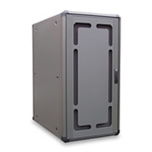
Providing comprehensive cooling for high-specification hardware and controlling noise pollution are both escalating concerns right across deployment sectors. This unique product provides a 'complete environment solution' meeting the thermal requirements of high-spec hardware (such as Blade Servers) combined with dramatic noise reduction across the audible spectrum.
This prototype demonstrates the combination of 'Passive Noise Control' using specialist soundproofing materials with emerging 'Active Noise Control' Technology (ANC) to yield impressive noise reduction in both low and high frequencies.
|
|
 |
 |
Computers of today and tomorrow are increasingly fast and demand far more powerful components. To ensure adequate cooling systems to combat the generated heat, more powerful fans are required which can produce serious amounts of unwanted noise. This noise can cause significant problems, for example, a stack of several blade servers can produce noise in excess of 85dB(A) which can be extremely difficult and stressful to work next to, and will require action by law once the European Directive is implemented in April 2006.
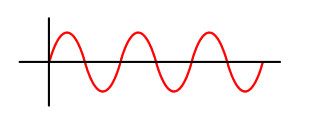
Initial sound wave (pure tone for this example)
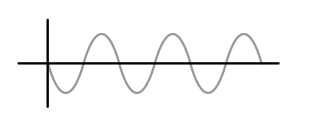
Exact mirror image (similar but opposite phase)
Added together they 'cancel' each other out
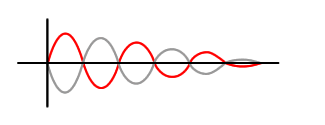
Silentium's 'Silence in a Chip' Active Noise Control
Passive noise control has been used to good effect for a long time. Acousti Products uses these methods in every product we produce. Each product is optimised for noise reduction using sound-damping acoustic materials, anti-vibration mounts and overall acoustic design.
Insulation materials are particularly effective in the middle and high-frequencies of the sound range.
The concept of Active Noise Control, or 'Anti-Noise' involves taking a sound wave and producing an exact mirror image. By adding these two sound waves together they "cancel" each other out and the resulting pressure is zero so the waves hitting the ear drum at the same time would not produce any sound.
If the high-pressure part of one wave lines up with the low-pressure part of another the two waves interfere destructively and there is no more pressure fluctuation, therefore no more sound.
Although this idea was recorded back in the 1930's it only came into practical use with the advance of digital technology. A standard Active Noise Cancellation System uses a sensor/microphone near the sound source, a processor to compute the exact mirror of the original sound, a speaker to emit the sound and error microphones to detect when the system is not working and to correct it via the processor.
Active Noise Control can be particularly effective for low-frequency sound waves.
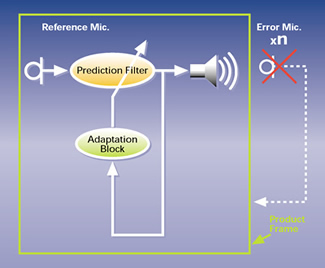
Silentium Ltd have developed a revolutionary state of the art approach to "Anti-Noise". Instead of using a sensor and microphone near to the source, a chip is embedded AT the source of noise, virtually altering the sounds directly.
This is achieved by utilizing smart proprietary algorithms, which adaptively learn the environment and are implemented in real time.
This approach eliminates the need for error microphones. The result is a small, low-cost yet highly effective solution to low-frequency noise which can be applied to many different applications.
Acousti Products has teamed up with Silentium to produce a solution to noisy rackmount equipment that is effective across the audible spectrum, significantly reducing both low and high frequency sound waves.
Home | About | Solutions | News | Sitemap | Terms | Privacy | Contact
Acousti Products is a division of The Rack People™, a company registered in England & Wales
No. 04514007. Registered Office: Lifford Hall, Lifford Lane, Kings
Norton, Birmingham, B30 3JN UK (previously named Acousti Products Ltd
- change of name May 2013).
All Rights Reserved. Graphics and
content ©2013 The Rack People™
 Callback
 Message
 Online Demo
 More details...
 Back to Newsroom